
16 October 2026 · 6 min read
Strong identity, loosely held
Two words once shaped a decade of my life. Here is what coral reefs, a crab and an ecologist's lens taught me about holding your identity strong, but loosely.
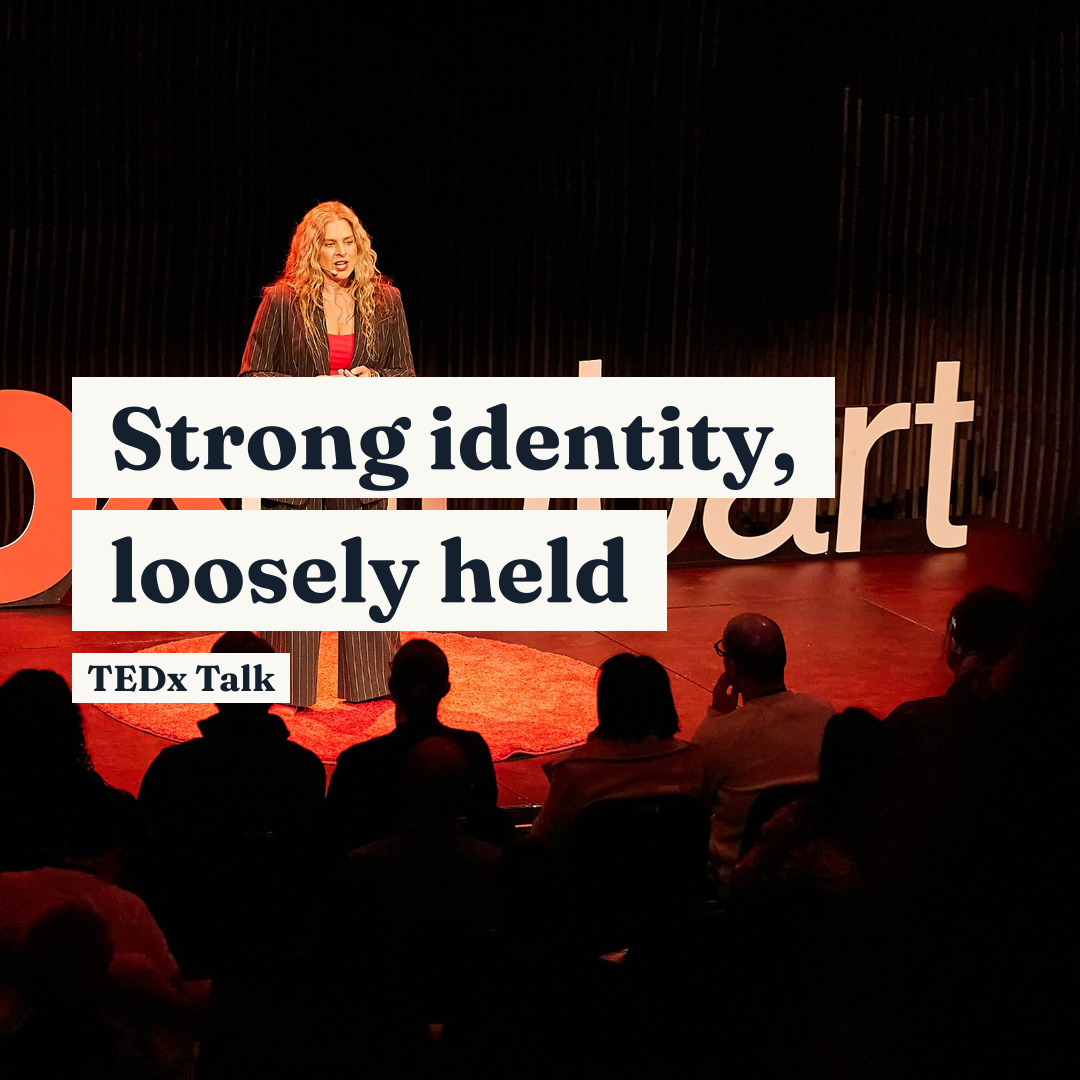
Think of a moment when someone's words cut straight through you. A classmate called you slow. Someone said you were the sensitive one, or not very athletic. Words spoken in a moment and carried for years.
Mine came on my honeymoon. We had been out dancing and I was happy, carefree and fully myself. Back in our room, my now ex-husband, angry and jealous, told me I was one of those half beautiful women who thinks she's beautiful.
I shrank. I silenced my voice and stopped dancing. For the next decade I hid in the shadows, not because it was true, but because I let those two words become my identity.
We can't control the cruelty of others. We can control what we do with it. That is the heart of my TEDx Hobart talk.
A rigid identity is a health risk
When your sense of self is fused to a single role, label or quality, your nervous system has to keep defending it, whether the label was handed to you or earned through hard work. A threat to that identity can set off a stress response much like the one you would have if a predator were chasing you. Chronic stress of this kind is linked to rising cortisol, weaker immune function, faster cellular ageing and declining cognition.
So a rigid identity is not only psychologically fragile. It is a physiological health risk, and the more outward success you have, the riskier it can get.
I have watched brilliant scientists break under the pressure of elite academia. Their identities were so fused with being a top scientist that when grants failed or funding was cut, they had nowhere to go. The identity couldn't flex, so the person did.
I see the same in executives who run wellbeing workshops for their teams, yet won't look at their own rest, self-talk or stress. The identity of high performer has become so tangled up with the suffering that they can't read it as the body's signal.
What an ecologist sees
I have a doctorate in ecology. I spent years studying how living systems survive, and what makes them collapse. In nature, it isn't the strongest species that survive. It's the most adaptive.
During my master's research I worked in a marine laboratory in Jamaica, studying how corals adapt to warmer seawater. The corals that couldn't adapt bleached, and many died. The ones that could adapt endured. That is the science of adapting, and it applies to your identity as directly as it does to a reef.
Then there is the crab. It grows into its shell until there is no room left, then sheds the whole thing and hides under a rock, soft and vulnerable, while a bigger one forms. A crab that clung to its old shell would die inside a structure it had outgrown.
Your identity is your shell. It's strong, it protects you, and it serves you until it doesn't.
Adaptive self-awareness comes first
Most advice tells you to grow and be flexible. It skips what has to come before. I call it adaptive self-awareness: seeing yourself clearly enough to know when change is needed, then having the courage to act while you still can, before an emergency forces your hand.
It isn't about being swayed by every opinion. You are not becoming a chameleon. It's an honest question: is this still serving me, or am I defending a shell I've outgrown?
That question found me in a meeting during my time in academia. I was surrounded by colleagues who were burning out, each carrying the visible toll of unsustainable high performance. I sat back, listened, and knew I was on the same path. It was time to shed my shell, so I left. Today I translate the research into life, helping people thrive.
That's the courage this skill asks for: making the change while you still have the choice.
Strong, and loosely held
Strong, because a vague identity gives you no foundation. You need to know who you are and what you believe at your core.
Loosely held, because a rigid one will eventually break you. That means two things.
First, let your identity evolve as you do. If it lags decades behind, it keeps you small and stressed.
Second, diversify. A healthy ecosystem has many species, and a healthy sense of self has many parts: public and private, professional, relational, creative. Think of it as your portfolio of self. If you are only the parent, only the achiever or only the executive, your identity is a house of cards. One job loss, one relationship ending or one diagnosis, and it can fall.
Psychologists call the alternative high self-complexity. People who have it tend to experience less stress, recover faster from setbacks and keep better mental health through life's transitions.
Three practices
Get still and listen. I mean this literally. Close your eyes and ask: who are you beneath the roles, the labels and the stories? Who are you becoming? That quiet voice is your most reliable compass, and it gets louder the more you listen. It's how I knew it was time to leave academia.
Cultivate complexity. Build depth across your relationships, hobbies, interests and work. When the kids leave home or a job ends, you'll be okay, because you're not a single point of failure.
Choose deliberately. Every action and thought casts a vote for who you are becoming. An identity was handed to me, and I held on to it for a decade before I shed it. Now I use a simple technique with my clients. Say "I'm the type of person who..." and finish the sentence with the identity you are authoring. Who speaks up for what I believe in. Who moves my body every day. Who rests without guilt. It works because it targets your actions, and each action in line with the identity you chose strengthens the pathways that make it feel natural. Your habits become the evidence.
Update the system
Today I am a scientist and a storyteller, a Lebanese girl from Mississippi and a Tasmanian mother of three, a writer, a dancer, a surfer and a swimmer. An expert in some things and a complete novice in others. Strong, beautiful, messy, real.
I choose who I am, deliberately, every day, and I'm not afraid to update the system. The species that thrive know when to hold their form and when to shed their shell. Your identity is your shell. Make it strong, hold it loosely, and have the courage to shed it when the time comes.
One thing to try today: name one label you carry, given or earned, that you treat as all of you. Then write one sentence beginning "I'm the type of person who..." that has nothing to do with it.
Planning a conference or leadership event? Book this keynote for your stage.